I have just been watching a programme on RTE about the Queen's visit to Ireland last year. It was an event that was deeply healing and is still being talked about there. Before the visit, the Irish Ambassador in London threw a party for the Prince of Wales and the Duchess of Cornwall; it featured many people from the Irish community in Britain, both the famous and the not-so-well known. Two among the famous caught my eye; Bob Geldof was there, as one might expect. But the figure standing next to him was none other than Ian Paisley. A willing guest in the Irish Embassy! How far we have come, indeed!
When we have so much to lament in our world, there are also things to be grateful for.
Monday, 16 January 2012

Irish and the Liturgy
A few days ago, I stumbled across the blog Lux Occulta, and rather liked it, so included it in my links section, where you can find it. I was a little intrigued by one post, called The Myth of Catholic Exceptionalism in which the author, Shane, takes issue with those on the Catholic Blogosphere who have characterized the Irish Catholic Church of the 1950s as an 'insular, peasant-led, anti-intellectual, aliturgical backwater.' I had an uneasy feeling that I might have been one of those he was rebuking. He left a comment on the last post which reinforced my suspicion.
But either he has misunderstood me in my earlier posts, or I did not express myself very well.
From the earliest days Ireland has regarded herself as indisputably part of the Western Latin Church. Those who would put blue water between her and the Holy See have had to struggle hard; there has been a myth among Anglicans that saw the Celtic Church (their sort-of predecessor, some believed) as a bravely independent body tricked into Roman submission at the Synod of Whitby (664). A look at the life of, say, St Columbanus (d.615) would give the lie to that immediately. In it we see both a devotion to the See of Peter and yet also a very different way of looking at things (not least regarding the relative importance of bishops and abbots).
Throughout the English occupation of Ireland, and especially after the Reformation, there can be no doubt of Ireland's attachment to the universal Catholic Church; indeed bishops continued to be appointed, and took up their sees whenever possible—there was often even a nuncio (or 'internuncio'). The Church was unquestionably under pressure, but never severed its link to the mainstream Church.
There are those who argue that there was a Gallican streak in Irish Catholicism, and there is a certain amount of evidence for this; many priests were trained in France, and I have heard that this accounts for the use of red sanctuary lamps throughout the British Isles (red being the French local colour for the Blessed Sacrament). But when we come to the twentieth century there can be no doubt whatever of the attachment of Ireland to the Holy See: the Eucharistic Congress in Dublin, 1932, brought a great outpouring of loyalty to the Pope.
Others may have thought Ireland a backwater; she never thought of herself that way.
Nor did Ireland lack intellectual muscle. It has always, proverbially, been a reading nation, and the establishment and quality of the National University has led to Ireland, a tiny country, being ranked eighth in the world for its high proportion of quality universities. Seven of these were in 2008 ranked by the Times Higher Education Supplement as among the 500 top universities in the world.
Shane exhorts me to write with care about the Liturgical Movement in the 1950s in Ireland because, he writes, it is a subject he knows something about and (he gently implies) I plainly don't. I confess I know very little at all about the progress of the Liturgical Movement in Ireland, and would be very interested to read anything that Shane might write (and I do hope he will). I have never seen much serious evidence for the Movement, though, on the ground. That it was present is highly probable, especially in seminaries and cathedrals; that it never crossed my path is undeniable.
I think, for instance, of the rebuilding of St Columcille's Church in Kells. Co Meath, which took place under the inspiration of the great parish priest Fr McCullen, in the very early 1960s, I think. An spatially-inadequate and ornate 19th century church was demolished (with difficulty, as it turned out—the excuse had been that the old one was about to fall down) and a new one built. Now, to my eyes, it shows a lot of Liturgical Movement influence. Pictures on the web, alas, are few and far between.

It is a very large building, without pillars or columns, so that everyone could have a view of the high altar under a simple tester, raised up on many steps. There were only two side altars, in the traditional Irish position, to the left and right of the high altar—none at all down the nave. Votive candles were strictly forbidden. The interior is very pleasing and harmonious, at least as designed, though it has had some unsympathetic reordering in recent years.
(The Blessed Sacrament is not now reserved , as one might suppose, on the old high altar, but behind Bishop Smith, and the old tester has been removed. The screen has been added, rather jarring with the style of the building) A new altar, as you can see, has been added in the nave.

The building is a good one, but I have never experienced a Mass there which was not hurried—oh, correction; a visiting priest last week celebrated beautifully. I was once (several years ago) rebuked by a resident priest for taking a whole half hour to celebrate a Sunday Mass (including sermon and many many communions).
My point has always been that good or bad liturgy has never been vital to the spirit of the Irish Church; it has relied on other things, and so has survived both a lack of liturgy in the penal days and bad liturgy today. Call the other things 'peasant' if you want; I would not, for everyone practised them. What I want to do in another post is to look at some of those things and find a Catholic rationale for them.
Of course you could always find good liturgy; the point is that is was not commonplace. And is probably less so today.
But either he has misunderstood me in my earlier posts, or I did not express myself very well.
From the earliest days Ireland has regarded herself as indisputably part of the Western Latin Church. Those who would put blue water between her and the Holy See have had to struggle hard; there has been a myth among Anglicans that saw the Celtic Church (their sort-of predecessor, some believed) as a bravely independent body tricked into Roman submission at the Synod of Whitby (664). A look at the life of, say, St Columbanus (d.615) would give the lie to that immediately. In it we see both a devotion to the See of Peter and yet also a very different way of looking at things (not least regarding the relative importance of bishops and abbots).
Throughout the English occupation of Ireland, and especially after the Reformation, there can be no doubt of Ireland's attachment to the universal Catholic Church; indeed bishops continued to be appointed, and took up their sees whenever possible—there was often even a nuncio (or 'internuncio'). The Church was unquestionably under pressure, but never severed its link to the mainstream Church.
There are those who argue that there was a Gallican streak in Irish Catholicism, and there is a certain amount of evidence for this; many priests were trained in France, and I have heard that this accounts for the use of red sanctuary lamps throughout the British Isles (red being the French local colour for the Blessed Sacrament). But when we come to the twentieth century there can be no doubt whatever of the attachment of Ireland to the Holy See: the Eucharistic Congress in Dublin, 1932, brought a great outpouring of loyalty to the Pope.
Others may have thought Ireland a backwater; she never thought of herself that way.
Nor did Ireland lack intellectual muscle. It has always, proverbially, been a reading nation, and the establishment and quality of the National University has led to Ireland, a tiny country, being ranked eighth in the world for its high proportion of quality universities. Seven of these were in 2008 ranked by the Times Higher Education Supplement as among the 500 top universities in the world.
Shane exhorts me to write with care about the Liturgical Movement in the 1950s in Ireland because, he writes, it is a subject he knows something about and (he gently implies) I plainly don't. I confess I know very little at all about the progress of the Liturgical Movement in Ireland, and would be very interested to read anything that Shane might write (and I do hope he will). I have never seen much serious evidence for the Movement, though, on the ground. That it was present is highly probable, especially in seminaries and cathedrals; that it never crossed my path is undeniable.
I think, for instance, of the rebuilding of St Columcille's Church in Kells. Co Meath, which took place under the inspiration of the great parish priest Fr McCullen, in the very early 1960s, I think. An spatially-inadequate and ornate 19th century church was demolished (with difficulty, as it turned out—the excuse had been that the old one was about to fall down) and a new one built. Now, to my eyes, it shows a lot of Liturgical Movement influence. Pictures on the web, alas, are few and far between.
It is a very large building, without pillars or columns, so that everyone could have a view of the high altar under a simple tester, raised up on many steps. There were only two side altars, in the traditional Irish position, to the left and right of the high altar—none at all down the nave. Votive candles were strictly forbidden. The interior is very pleasing and harmonious, at least as designed, though it has had some unsympathetic reordering in recent years.
(The Blessed Sacrament is not now reserved , as one might suppose, on the old high altar, but behind Bishop Smith, and the old tester has been removed. The screen has been added, rather jarring with the style of the building) A new altar, as you can see, has been added in the nave.

The building is a good one, but I have never experienced a Mass there which was not hurried—oh, correction; a visiting priest last week celebrated beautifully. I was once (several years ago) rebuked by a resident priest for taking a whole half hour to celebrate a Sunday Mass (including sermon and many many communions).
My point has always been that good or bad liturgy has never been vital to the spirit of the Irish Church; it has relied on other things, and so has survived both a lack of liturgy in the penal days and bad liturgy today. Call the other things 'peasant' if you want; I would not, for everyone practised them. What I want to do in another post is to look at some of those things and find a Catholic rationale for them.
Of course you could always find good liturgy; the point is that is was not commonplace. And is probably less so today.
Told you so
At the time of Ireland's closure of its Vatican embassy, I remarked to several people that Enda Kenny and his government would come to regret it. 'It will come back and bite them', I said. 'They underestimate the residual loyalty of Ireland to the faith, and are simply playing to those they think are in the gallery.'
I considered blogging upon it, but decided not to; besides, those days before Christmas were simply too busy and I didn't do much blogging at all.
I want to write some more on Ireland, and will do so soon. In the meantime, you can read the account here, thanks to Fr Z.
I considered blogging upon it, but decided not to; besides, those days before Christmas were simply too busy and I didn't do much blogging at all.
I want to write some more on Ireland, and will do so soon. In the meantime, you can read the account here, thanks to Fr Z.
Tuesday, 10 January 2012
Indolence and truth
Journalists are apt, like most of the human race, to take a shortcut wherever possible. The surprise that the Vatican obtained information for its biographies of the new cardinals-elect from Google (Archbishop Dolan is a Catholic, that sort of thing), directly lifted and without attribution, is but one example.
The précises of Papal homilies is another example. Inevitably journalists pick on the one phrase that they think will interest their readers, usually some sort of a negative comment, as you can read here on First Things:
http://www.firstthings.com/onthesquare/2012/01/benedict-doesnrsquot-make-headlines
(Thanks to The Pulpit, and apologies that I can't put in links very well; they aren't easy to do on an iPad)
Wouldn't it be sensible for the Vatican Press Office to send around to the accredited journos not just the full text of the Holy Fathers' homilies, but a predigested account of the central message? Just a paragraph that the journos can tweak a bit to make it different enough not to be accused of plagiarism, or to make the Telegraph's account not too like the Guardian's. Perhaps with a bottle of whiskey to encourage the journos to use that rather than trawl through the homily itself to find the most potentially inflammatory phrase (when portrayed in a particular way)
This, of course, suggests that the Holy See provide some more help to the indefatigable Fr Lombardi, who always appears to project a strange mixture of puzzlement and confidence, of blind panic and quiet reassurance.
Sunday, 8 January 2012
Friday Abstinence again
I noticed that The Bones had a dilemma about whether or not to eat meat last Friday, it being the livid scar of the feast of the Epiphany. I, too was in a dilemma.
You see, I was travelling. It is my memory that travellers were dispensed from abstinence, but in their restoration of Friday abstinence, our bishops did not grant dispensations (at least explicitly) or specify when these might apply. I think that in the old days a parish priest might dispense his parishioners for a good reason, and in certain cases (such as when travelling) the dispensation was automatic. I should have liked to see a dispensation for dining when others (who are not Catholics) have cooked and when one does not wish to cause an awkwardness. In fact our bishops explicitly directed that in such cases we were to explain to our friends that we were not permitted to eat their food, but to explain to them charitably a concept that few Catholics understand these days. It would appear to amount to:
'well, no, it isn't about doing penance, because we left all that behind us forty years ago. It is actually about us feeling good about being Catholics and being different, and this being a good witness to you about Living Simply'.
So you get to inconvenience, annoy, exclude and patronise your hosts all at one time. Fun.
Like old Boney, I thought about it being the real feast of the Epiphany, and about travelling, and so at the airport I hovered over a chicken salad sandwich before good old Catholic Guilt won out and I took the egg mayonnaise.
On arrival in my uncle's house, he was already laying a chicken casserole on the table as I came through the front door. I ate it with him. Now, we are in Ireland, and the law of abstinence doesn't apply here. But I still felt guilty, and wondered whether I should be inconveniencing, annoying and patronising him to do my religious duty.
Last night we went to the only Sunday Mass in the parish -- strangely late on Saturday night, and it was carefully explained that as we had celebrated Epiphany last Friday, the Mass would be that of the Baptism of the Lord. So even had the abstinence laws applied in Ireland, my uncle was right to serve meat, and I had felt guilty for nothing ( even though I know that I had no need to anyway).
As for the new translation in Ireland; well the stories you hear about it being a disaster area are not correct. My uncle tells me the there was some grumbling from some of the priests (during Mass of course), but that the laity just got on with it. That was my experience, too. Everyone said the prayers at their own pace as usual, the speed ranging from very fast to lightning, and all but one of the people near me were using the new text without leaflets except for the Gloria and Creed. Only one person kept up the old responses, but as she was going faster than any others around her that was perhaps to be expected. The celebrant didn't stumble or grumble once (though he ad libbed from time to time), and he encouraged the correct people's responses by saying them loudly into the microphone faster than anyone else. Only at one point did all the congregation pray all in solemn unison instead of the usual in-your-own-time,-folks style, and that was the Pater Noster, said in Irish. I really am going to have to learn that.
I asked about the lapsation in light of the recent troubles of the Church, and here in the wild and wooly parts of County Clare it doesn't seem to be a problem; Mass attendance is still about 90-95%, and even draws in the increasing number of (non-Catholic) immigrants from England, Germany and elsewhere, who have discovered for themselves what an important part of social cohesion the Church is here. Well, it's nice to hear some good stuff, isn't it?
They hadn't heard about the new Nuncio, but were highly amused to hear that he he is called Charlie Brown. No doubt he will be presented with a dog soon.
Thursday, 5 January 2012
A very different way of doing the first reading
Here, from the Sarum Christmas Missa in Gallicantu, beginneth the first reading:
(translation further down, should anyone need it)
(translation further down, should anyone need it)
Duo clerici de secunda forma in capis sericis in pulpito simul cantent lectionem.
Laudes Deo dicam per sæcula, qui me plasmavit in manu dextera, atque redemit cruce purpurea sanguine Nati.
Hic cantetur alternatim:
Lectio Esaiæ Prophetæ.
In qua Christi lucida vaticinatur nativitas.
Hæc dicit Dominus.
Pater, Filius, Sanctus Spiritus, in quo sunt omnia condita superna atque ima.
Populus gentium qui ambulabat in tenebris
Quem creasti: quem fraude subdola hostis expulit paradiso: et captivatum secum traxit ad tartara;
Vidit lucem magnam;
Fulserunt et immania nocte media pastoribus lumina.
Habitantibus in regione umbræ mortis: Lux
Sempiterna et redemptio vere nostræ
Orta est eis.
O stupenda nativitas,
Parvulus enim natus est nobis,
Magnus hic erit Jesus Filius Dei.
Et Filius
Patris summi,
Datus est nobis.
Ab arce summa prædictum sic erat.
Et factus est principatus super humerum ejus.
Ut cœlos regat atque arva.
Et vocabitur nomen ejus,
Messias, Sother, Emmanuel, Sabaoth, Adonai.
Admirabilis,
Radix David,
Consiliarius
Dei Patris,
Deus
Qui creavit omnia,
Fortis
Barathri claustra perimens teterrima
Pater futuri sæculi,
Rex omnipotens et cuncta regens,
Princeps Pacis
Hic et in ævum.
Multiplicabitur ejus imperium.
In Hierusalem, Judæa, sive Samaria,
Et pacis non erit finis,
Per sæcula sempiterna,
Super solium David et super regnum ejus sedebit, Et regni meta sui non erit aliqua.
Et confirmet illud,
In fidei pignore.
Et corroboret in judicio, et justitia,
Judex cum venerit judicare sæculum.
A modo
Illi debetur gloria, laus et jubilatio.
Et usque in sempiternum.
Hic cantent usque ad finem:
Ab ortu solis usque occiduos,
ad fines mundi orbis per climata
laus Creatori resonet congrua.
Amen dicant omnia.
Let two clerks of the second bench, in silk copes, chant this Lesson together in the pulpit:
I will sing praises to God for ever, Who formed me in His right hand and redeemed me on the cross with the purple blood of his Son.
Then alternately:
The Lesson of Esias the Prophet.
In which is foretold the glorious birth of Christ.
Thus says the Lord,
Father, Son and Holy Spirit, by whom are created all things in heaven and earth,
The people that walked in darkness
whom you created, whom the enemy expelled from Paradise by a subtle fraud and led captive with him into hell,
Have seen a great light.
And at midnight strange brightness shone on the shepherds,
On those who dwell in the shadow of death, a light
Everlasting, and our true redemption,
has shined.
O stupendous birth!
For unto us a child is born,
Jesus the Son of God; he shall be great,
A son
Of the highest Father
is given to us
So had it been foretold from the throne on high.
And the government shall be upon his shoulder,
That he may rule heaven and earth.
And his name shall be called
Messiah, Soter, Emmanuel, Sabaoth, Adonai,
Wonderful,
The Root of David,
Counsellor
of God the Father,
God
who created all things,
Mighty,
overthrowing the hideous gates of hell,
The everlasting Father,
King Almighty and governing all,
Prince of Peace
Here and for ever,
Of the increase of his government
In Jerusalem, Judea and Samaria,
And peace there shall be no end,
For ever and ever,
Upon the throne of David, and upon his kingdom
and there shall be no bounds to his reign,
To order it
In the bonds of faith
And to establish it with judgment and with justice,
when he shall come as Judge to judge the world.
From henceforth
to him be due glory, praise and rejoicing
and for ever and ever.
Here let them sing together to the end:
From the rising of the sun to its setting
let fitting praise resound to the Creator
through all places to the ends of the world
and let everything say Amen.
Sunday, 1 January 2012
By gum!
And here was I thinking that I was an all-Irish product. My mother, at seven minutes past 2011, reveals that my great-grandmother, one Mary Burnell, was a Yorkshirewoman.
Happy new year, everyone.
Happy new year, everyone.
Saturday, 31 December 2011
To elevate or not to elevate
 Not that long ago I was upbraided for my unrubrical celebration of the Mass. I was somewhat stung, as I thought that I do take a lot of care do say the black and do the red, as Fr Z would put it. My particular offence was that
1) I elevated the Host and Chalice high after each consecration, and
2) not high enough for the 'Per Ipsum'.
It was pointed out to me that the rubric directs, after the Consecration that the priest
Hostiam consecratam ostendit populoand, after the chalice:
Calicem ostendit populo.The priest is to show the Host and Chalice to the people, and no more. This is underlined by the instruction that at the Per Ipsum, the priest is actually to elevate the Host (on the paten) and Chalice:
Accipit patenam cum hostia et calicem, et utrumque elevans, dicit: Per ipsum…Therefore, I was instructed, I should lift chalice and paten high for the Per Ipsum, and merely present (as it were) the Host and Chalice after the consecration.
I took the point that this was indeed what the text said, but mutinously continued to maintain my practice, only with an uneasy conscience, on the grounds that
a) my practice was sanctioned by tradition,
b) I thought the other looked silly and (I'm afraid)
c) I wanted to.
I thought to mention this on a post that Fr Z put up yesterday, and then went to check some facts. Interestingly, I discovered that the Extraordinary Form also directs that the priest after each Consecration:
ostendit populo [Hostiam & Calicem]and, at the Per Ipsum,
elevans parum Calicem cum Hostia, dicit 'omnis honor et gloria'.
Now it is very clear from a hundred liturgical commentaries that the 'showing' at the Consecration is a lifting up high, while the elevation at the Per Ipsum is parum, a little.
Here the Sarum use may be of help, being more explicit. The Celebrant is directed to
elevet [hostiam] super frontem ut possit a populo videri(let him raise the Host over his forehead that it might be seen by the people)
and
elevet calicem usque ad pectus vel ultra caput.(let him raise the Chalice to his chest or over his head)
In using the same expressions in the same places, Mgr Bugnini was clearly intending that the rubric be interpreted exactly as it always has been interpreted otherwise he would have made a change (as he did in requiring that the paten be involved in the Per Ipsum). And therefore, I contend, it is those who do not lift the Host high after the Consecrations who are being unrubrical.
There is, by way of interest, another useful connection that can be made. I do not think that this has any ancient witness to it (unless some of you know different), but surely there is an interesting parallel between the elevation and the crucifixion:
John 3:14— And as Moses lifted up the serpent in the wilderness, so must the Son of Man be lifted up,
John 8:28 —When you have lifted up the Son of Man, then you will know that I am he,
John 12:32—And I, when I am lifted up from the earth, will draw all people to myself. (ESV)
At least catechetically, then, there is an important connection to make in people's minds here.
Sunday, 18 December 2011
Christmas Prefaces
First, the ordinary tone, which to my mind definitely needed some adjustment:

And I thought I'd have a go at setting it to the tonus sollemnior (Ben having reminded me in the last post). It actually seems to work rather better than I thought it might, though the proof of the Christmas pudding will be in the eating.
If these are any use to you, I dare say you could easily print them off. I wrote them on A4 paper, so if you're using American Letter, you might need to scale down a little.
The resolution could be higher, and I could replace these with a clearer version if anyone thinks it a good idea.
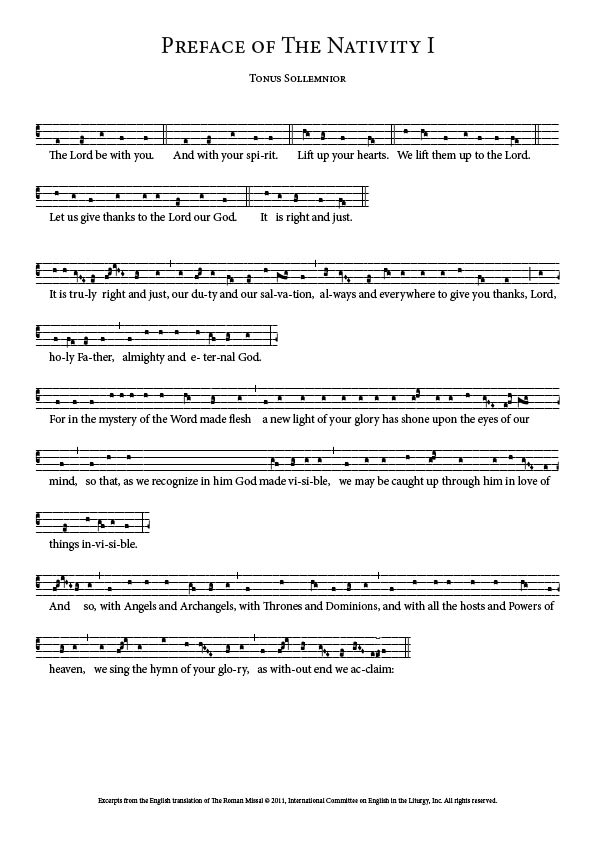
And I thought I'd have a go at setting it to the tonus sollemnior (Ben having reminded me in the last post). It actually seems to work rather better than I thought it might, though the proof of the Christmas pudding will be in the eating.
If these are any use to you, I dare say you could easily print them off. I wrote them on A4 paper, so if you're using American Letter, you might need to scale down a little.
The resolution could be higher, and I could replace these with a clearer version if anyone thinks it a good idea.
Saturday, 17 December 2011
Prefaces
On the whole I am pretty happy with the new translation. One thing, though, that I find particularly irritating is that the prefaces have not been set well to music. My spies tell me that the musicians had almost no time to reset the prefaces once Mgr Moroney had stopped tinkering, so did a rush job.
No doubt many celebrants have experienced the same thing. Particularly awkward is the fact that the musicians don't seem to have noticed that prefaces fall into three 'paragraphs' which need separate musical treatment. Some of the settings remind me of priests who can't read music, and have a go at vaguely fitting the tune to the words without preparing it first (we've all encountered those priests).
The preface for Advent I wasn't very good, nor others I've looked at, so I thought that I'd have a go myself. Here's the one for this weekend, Advent II: actually the one in the missal is very nearly okay, and I've agreed with it almost everywhere. But it was good for me to get the practice. And I prefer square notes for this sort of thing.

No doubt many celebrants have experienced the same thing. Particularly awkward is the fact that the musicians don't seem to have noticed that prefaces fall into three 'paragraphs' which need separate musical treatment. Some of the settings remind me of priests who can't read music, and have a go at vaguely fitting the tune to the words without preparing it first (we've all encountered those priests).
The preface for Advent I wasn't very good, nor others I've looked at, so I thought that I'd have a go myself. Here's the one for this weekend, Advent II: actually the one in the missal is very nearly okay, and I've agreed with it almost everywhere. But it was good for me to get the practice. And I prefer square notes for this sort of thing.
Friday, 16 December 2011
Services of Reconciliation
Yesterday I held two 'reconciliation services' in the parish; one in the morning at our smaller centre, where some twenty (more senior) people came and another in the evening in the main church. I had asked two other priests to help, and they kindly came. The participants? Ten. From a Sunday Mass attendance of between 250 and 350.
I have read so often that the reason people do not come to confession is that the priests are failing in their duty to preach about it, or make opportunities. In this parish, I offer an hour and a half every week (distributed through the three churches) (when I sit alone saying my breviary), and a conveniently timed 'reconciliation service' during Advent and Lent. And I do preach about it. Occasionally very directly.
In the past, I have been told that it is 'forbidden' to hear confessions during Mass. I know that this advice is false.
I should add that the times are calculated to be easy and available, and that the opportunity in the main church coincides with the hour's exposition of the Blessed Sacrament that happens daily.
I know excellent priests who hear confessions before every Mass; these tend to be city-centre parishes, and this would simply not work here.
So, I would be interested to know whether anyone has tried the experiment of having visiting priests hearing confessions during Sunday Mass a couple of times a year.
Or, frankly, I would be grateful for any advice at all.
I am very depressed about this. My parishioners clearly think that they are saints. Some may be, but most, I suspect, are no more saintly than I am. Well, perhaps a little bit more.
I have read so often that the reason people do not come to confession is that the priests are failing in their duty to preach about it, or make opportunities. In this parish, I offer an hour and a half every week (distributed through the three churches) (when I sit alone saying my breviary), and a conveniently timed 'reconciliation service' during Advent and Lent. And I do preach about it. Occasionally very directly.
In the past, I have been told that it is 'forbidden' to hear confessions during Mass. I know that this advice is false.
I should add that the times are calculated to be easy and available, and that the opportunity in the main church coincides with the hour's exposition of the Blessed Sacrament that happens daily.
I know excellent priests who hear confessions before every Mass; these tend to be city-centre parishes, and this would simply not work here.
So, I would be interested to know whether anyone has tried the experiment of having visiting priests hearing confessions during Sunday Mass a couple of times a year.
Or, frankly, I would be grateful for any advice at all.
I am very depressed about this. My parishioners clearly think that they are saints. Some may be, but most, I suspect, are no more saintly than I am. Well, perhaps a little bit more.
Wildlife
I have been receiving emails encouraging me to engage in some sort of competition. The prize, apparently, is to see some arctic monkeys. I do enjoy those David Attenborough programmes, and have seen polar bears (not nearly as cuddly as one might suppose), though never arctic monkeys.
Someone suggested that it might be the name of some pop group. Sounds very unlikely to me, though of course the Beetles are named after insects. What's become of them? I haven't heard them for some time.
But now I have a worry: if I enter this competition, I might stand some remote chance of winning. And if I won, perhaps they would make me go to the performance. I don't think I should like that. Flower power was never my thing.
Someone suggested that it might be the name of some pop group. Sounds very unlikely to me, though of course the Beetles are named after insects. What's become of them? I haven't heard them for some time.
But now I have a worry: if I enter this competition, I might stand some remote chance of winning. And if I won, perhaps they would make me go to the performance. I don't think I should like that. Flower power was never my thing.
Monday, 12 December 2011
Mythapprehensions
 I had an enquiry this morning from one of my ecumenical opposite numbers about the song A Partridge in a Pear Tree. She had heard that this was a sort of catechetical song of the Catholic Underground during penal times. This is an explanation that I have heard, too, but I have to say that I don't find it remotely convincing. The only thing that it might teach is a child to count backwards from ten; what one might want a child to learn is not that there are seven sacraments so much as what those sacraments are—children would learn that there are seven anyway.
Several of these sorts of crypto-Catholic practices were described in Fr Mark Elvins' book Old Catholic England, and I hesitate to say that I think that lots of these connections are simply fantasy, romantic invention, but, having hesitated [……], there, I'm afraid that I do think that they are just that.
I'd be interested to hear if anyone knows any more about it: I'd be very pleased if any sort of real connection were made between these things and the recusant period.
Saturday, 10 December 2011
Extraordinary Form Train and a very Ordinary Form church
While outside the church today, waiting to hear our 8-year-olds first Confessions, I was pleased to hear a chuffing in the distance from the railway line that runs past St Peter's. It's 34067 Tangmere, on the way to Bath.
Saturday, 3 December 2011
What if?
…and I write as a financial dunce (please don't rub it in)…
Catholics, Christians, were to put their money into those British Islamic banks that don't do usury? Or even have our own, similar, institutions?
In the end, has the ancient prohibition of usury been shown to have more behind it than might have appeared, say, ten years ago?
Catholics, Christians, were to put their money into those British Islamic banks that don't do usury? Or even have our own, similar, institutions?
In the end, has the ancient prohibition of usury been shown to have more behind it than might have appeared, say, ten years ago?
Friday, 2 December 2011
Monday, 28 November 2011
Giving the Jerusalem Bible a Belt
On Mondays I tend to start my week reading over the Gospel for next Sunday, moving on later days to commentaries. Next Sunday we will read the beginning of St Mark's Gospel, and, as usual this morning, I read it first in the Greek, and then used various translations to get the best sense. But I discovered a peculiarity. In 1:6, the strange clothing adopted by St John the Baptist is described:
καὶ ἦν ὁ Ἰωάννης ἐνδεδυμένος τρίχας καμήλου καὶ ζώνην δερματίνην περὶ τὴν ὀσφὺν αὐτοῦ, καὶ ἔσθων ἀκρίδας καὶ μέλι ἄγριον.
The Vulgate has:
Et erat Joannes vestitus pilis cameli, et zona pellicea circa lumbos ejus, et locustas et mel silvestre edebat.
Douai-Rheims:
And John was clothed with camel’s hair, and a leathern girdle about his loins; and he ate locusts and wild honey.
The English Standard Version (basically RSV) has:
Now John was clothed with camel’s hair and wore a leather belt round his waist and ate locusts and wild honey.
All pretty straightforward (the translations, I mean, not St John's clothing). However, when we come to the Jerusalem Bible, we get:
John wore a garment of camel-skin, and he lived on locusts and wild honey.
Strange. Where's the belt gone? A problem of the Lectionary, I thought; these things aren't unknown. I've even discovered a passage in a Gospel where the vital word 'not' is left out (though I can't remember where). But I went to my JB and checked. No belt. Okay; the plot thickens. What about the New Jerusalem Bible?
John wore a garment of camel-skin, and he lived on locusts and wild honey.
Just the same as old JB, in fact.
Perhaps there is a variant text in the Greek; this Sunday's Gospel had one; either 'Watch' or 'Watch and pray'. But no, there seems to be no disagreements among the Greek versions; John did indeed have a leather belt.
Finally, I tracked it down in the Jerusalem Bible (original) French version:
Jean était vêtu d'une peau de chameau et mangeait des sauterelles et du miel sauvage.
But a footnote adds:
Var: Jean était vêtu de poils de chameau et se ceignait les reins d'un pagne de peau.
There we are. But nobody else seems to think that not wearing a belt is an option. It's just a JB oddity, and, no doubt, they have found a manuscript to back them up, but not one that anyone else seems to have found.
It raises a point, though: what are we supposed to hear at Mass? The biblical critics' version, or that which the Church asks of us in the Latin original Lectionary?
It raises a point, though: what are we supposed to hear at Mass? The biblical critics' version, or that which the Church asks of us in the Latin original Lectionary?
On another point in this verse, the commentary by Dom Paul Delatte, once Abbot of Solesmes is delightfully French: for him it isn't enough to know that John ate locusts (sauterelles; grasshoppers)—he wants to know what they tasted like!
Les sauterelles de Palestine sont longues et fortes, grosses à peu prés comme des crevettes, et, assaisonnées de certaine manière, elles en ont le goût, paraît-il.
Palestinian grasshoppers are long and strong, roughly as big as prawns, and seasoned in a certain way, it would appear that they taste like them.
I have a delightful image of French gourmets haring off to the Judean desert and demanding salade des sauterelles avec sauce Marie Rose, perhaps followed by Gâteau du Foret Noir. Or perhaps not.
—and (a later thought) it seems that Delatte considered that John the Baptist might well have enjoyed his sauterelles assaisonnées de certaine manière. Perhaps with a glass of light Chablis?
—and (a later thought) it seems that Delatte considered that John the Baptist might well have enjoyed his sauterelles assaisonnées de certaine manière. Perhaps with a glass of light Chablis?
Thursday, 24 November 2011
St John Fisher
A couple of posts ago I mentioned that the Archbishop of Westminster has written a book about St John Fisher. It is now available, published by Alive Publishing.
ISBN 976-1-906278-13-7
or go here.
There is a very real danger that, simply because a man is Archbishop of Westminster, a book might (a) be published and (b) be dismissed by serious scholars.
This book is a real contribution both to scholars and to Christians generally who want to know more about Fisher. At the book launch last night in Archbishop's House, the eminent historian Eamon Duffy admitted privately that he had expected to have to 'flannel', because of who the author was, but he acknowledged that this work genuinely breaks new ground and contributes to our understanding of Fisher, not just as martyr, but as theologian and pastor. That is no mean accolade from our foremost English Reformation scholar.
Professor Jack Scarisbrick, who also spoke (and what an extraordinary man he is—the father (maybe with Haigh) of revisionist Reformation history) made the comment that whereas St Charles Borromeo has been considered the patron saint of the clergy, St John Fisher has an equal—if not greater—claim to the title. I have long thought this, and am delighted to hear it reaffirmed by so great an authority.
Professor Scarisbrick also mentioned Archbishop Peter Amigo in his talk, something that, I thought might set the foundations of the home of Cardinal Bourne a-trembling. But that's another story.
Do I recommend the book? Well, I've yet to finish it, but so far, I recommend it very highly. It is high time that St John Fisher was written about as confessor (in the old sense); as a genuinely holy and intelligent man who was saintly in his life as well as his death. It is good, too, to set him in his context and compare him to his contemporaries.
As for the launch, somebody asked me why I was invited. I said I didn't know, but I was pleased to be there. Thinking about it, I think that it was probably a mistake, and that they had meant to invite Fr Tim Finigan.
On other matters, I do apologize for the thin posting; parish work has been very pressing, extraordinarily so, and I've not been feeling at all well. Say a prayer, please.
No, don't assume it's anything serious; just lurgies, but debilitating ones. Good for my soul, if not my body.
ISBN 976-1-906278-13-7
or go here.
There is a very real danger that, simply because a man is Archbishop of Westminster, a book might (a) be published and (b) be dismissed by serious scholars.
This book is a real contribution both to scholars and to Christians generally who want to know more about Fisher. At the book launch last night in Archbishop's House, the eminent historian Eamon Duffy admitted privately that he had expected to have to 'flannel', because of who the author was, but he acknowledged that this work genuinely breaks new ground and contributes to our understanding of Fisher, not just as martyr, but as theologian and pastor. That is no mean accolade from our foremost English Reformation scholar.
Professor Jack Scarisbrick, who also spoke (and what an extraordinary man he is—the father (maybe with Haigh) of revisionist Reformation history) made the comment that whereas St Charles Borromeo has been considered the patron saint of the clergy, St John Fisher has an equal—if not greater—claim to the title. I have long thought this, and am delighted to hear it reaffirmed by so great an authority.
Professor Scarisbrick also mentioned Archbishop Peter Amigo in his talk, something that, I thought might set the foundations of the home of Cardinal Bourne a-trembling. But that's another story.
Do I recommend the book? Well, I've yet to finish it, but so far, I recommend it very highly. It is high time that St John Fisher was written about as confessor (in the old sense); as a genuinely holy and intelligent man who was saintly in his life as well as his death. It is good, too, to set him in his context and compare him to his contemporaries.
As for the launch, somebody asked me why I was invited. I said I didn't know, but I was pleased to be there. Thinking about it, I think that it was probably a mistake, and that they had meant to invite Fr Tim Finigan.
On other matters, I do apologize for the thin posting; parish work has been very pressing, extraordinarily so, and I've not been feeling at all well. Say a prayer, please.
No, don't assume it's anything serious; just lurgies, but debilitating ones. Good for my soul, if not my body.
Thursday, 27 October 2011
From the Excellent St Thomas More Legal Centre
THOMAS MORE LEGAL CENTRE
A Company limited by Guarantee, Co. No. 6381347
Registered Charity No. 1122184
IT IS TIME TO STAND UP FOR OURSELVES
A Catholic Mental Health Worker has been sacked by the NHS for gross misconduct. What was her offence? Treating elderly patients with callous disregard? Physically abusing mental patients? Ignoring patients who cried out for water? No, it was none of these. The charge against her is that she ‘distributed material which individuals may find offensive’.
Her ‘gross misconduct’ in fact arose from an amicable discussion with a colleague, NOT a patient, who worked as a receptionist organising abortion appointments. In the course of which she handed over the booklet Forsaken in which five women recount their experience of abortion and the mental problems they suffered afterwards. The colleague did not object to receiving the book and indeed is not being called as a witness by the NHS. The booklet contained no graphic images, and it was never suggested that it should be given to patients. The NHS objects to it because the booklet presents a ‘religious view’ of abortion, because one of the women talking about how she now views her Abortion regards it as a sin. Is the expression of a religious view now a sacking offence in Britain?
The Mental Health Worker’s case is being fought at the Central London Employment Tribunal on November 15th. Her legal representation is being provided by the Thomas More Legal Centre. In addition, we are planning to bring a case against the NHS in the County Court under the Human Rights Act for failure to respect the nurse’s right to freedom of expression, and her right to freedom of religion. Winning such a case would set an important precedent in defending the rights of Catholics to discuss their faith and beliefs with colleagues without fear
The Thomas More Legal Centre has a strong track record of dealing successfully with similar cases of discrimination through quiet representation of clients’ interests to employers who may have misinterpreted the law and failed to respect freedom of religion. The Centre has for example successfully represented a Catholic trainee Doctor who was told he would not be allowed to qualify unless he referred patients for Abortions, and also successfully represented two Catholic Nurses who were moved to an Abortion Clinic against their wishes. It has done this voluntary legal work supported by very modest funds to cover inescapable expenses of the charity. The Trustees have always felt that they should not make any public appeal for funds for the charity until a case arose which would have to go to court.
That time has now come. We are appealing for help from everyone who believes in the freedom for Catholics to say what they believe and keep their jobs. We need funds to meet the costs of legal representation and, as there are no certainties however strong the case, to cover the risk of County Court costs being awarded against our client (which could be up to £25,000). And we need prayer.
The Thomas More Legal Centre is pursuing the case in the confidence that the Catholic community will come together to support this Mental Health Worker . Because this is not just an injustice being done to an individual, it is a threat to the freedom of the whole Catholic community to express its beliefs.
Donations can be made by cheque (made out to Thomas More Legal Centre) to The Treasurer, Thomas More Legal Centre, Palmyra Chambers,
46 Legh Street,
Warrington
WA1 1UJ; or by bank transfer to Yorkshire Bank, 34 Princes Street, Stockport, Cheshire, SK1 1RE; sort code 05-09-33, account no. 43102195 (Thomas More Legal Centre). If you are a UK tax-payer making a gift by cheque, please send a signed statement with your name and address asking for the donation to be treated as Gift Aid.
Thank you for standing up for Catholic freedom.
Richard Kornicki CBE
Chairman of Trustees
Wednesday, 26 October 2011
A new book on St John Fisher

Along with my namesake, Fr Tim Finigan, I have long had a devotion to St John Fisher. His role as a martyr is well known, but I have always felt strongly that, had the course of history in these islands gone another way, and St John lived the full course of his natural life, that he would have been canonizable (is that a word?) as a Confessor.
Born a Yorkshireman (at Beverley) in 1469, he grew up in what I think we would call a middle-class family and showed early academic promise which led to his gaining a place at Cambridge University in 1484, where he early attached himself to the new approach to studies and theology now known as the Christian Humanist Movement. He followed what I think we can only call a brilliant academic career, and came to the notice of the extraordinary Margaret Beaufort, mother of King Henry VII. She has been variously judged by historians, supposedly being responsible with the widow of Edward IV, Elizabeth Woodville, for bringing the Wars of the Roses to an end by uniting the Lancastrians (in the person of Henry Tudor) to the Yorkists by the marriage of Henry to Elizabeth of York, and also for managing thereby to get her son onto the throne to which he had only the very slimmest of claims. Be that as it may, John Fisher had the highest regard for her and thought of her as little short of a saint.
Elected Vice-Chancellor of Cambridge University, he managed to persuade his wealthy friend Margaret Beaufort to endow two new colleges, St John's (he himself consecrated the chapel) and Christ's College, to study the new approach to theology and the scriptures; he attracted to Cambridge scholars of Greek and Hebrew, so that the Bible might be studied in its original languages.
It was inevitable that he be drawn into Royal circles, and the royal favour got him the diocese of Rochester, the poorest in the land. In later years he was nominated to Winchester, the richest, but refused it. He was elected Chancellor of Cambridge University, and pursued its interests at court assiduously. On the deaths of Margaret Beaufort and her son Henry VII, Fisher was chosen as the preacher.
The growth of the Lutheran Reformation disturbed him, and, at the instance of King Henry VIII, he preached a famous sermon at St Paul's, when Luther's writings were symbolically burned. He wrote assiduously against the Protestants, and has been suspected as the real author of the Assertio Septem Sacramentum, for which Henry VIII took the credit (and the title Defensor Fidei). He also wrote many spiritual works, such as his commentary on the Psalms.
He became something of a tutor and friend to the new King Henry VIII and his Queen, Catherine of Aragon, sharing with the Queen a real interest in fostering the new Christian Humanism, she promoting the scholar Juan Luis Vives, who served also as her chaplain.
Fisher could have become like so many other talented clerics of his day, a dedicated climber of the social ladder. But in his own life he maintained a strict austerity which kept him focussed on the one thing that matters. It was said that he cut a window in the wall of his study so that he could see the Blessed Sacrament at all times when writing. If there were people in Rochester whom the clergy would not visit because of the stench of their poverty, Fisher himself would go. When his rooms were searched for his valuables after his arrest, the King's commissioners, finding at last a single locked chest in his bedchamber, broke it open to reveal only a hair shirt.
The matter of the Kings's setting aside of Queen Catherine and his attempted marriage of Anne Boleyn is very well known, as is Fisher's part in it.
I remain deeply moved by his final hours; called early in the morning to be told he must die, he thanked his messenger, then rolled over and contentedly went back to sleep. Later, he dressed in his best clothes ('for this is my wedding day'), read the Bible one last time ('this is eternal life, to know you, the only true God, and Jesus Christ whom you have sent', John 17:3) and commented 'here indeed is learning to last me until my life's end'.
St John Fisher is surely the most wonderful patron for the secular priesthood in England and Wales: we already have St Thomas of Canterbury: St John deserves to be better known, in my view. And thank you, Archbishop Vincent, for bringing him to our attention once more. I look forward to reading the book.
Tuesday, 25 October 2011
Arrived!
There's no need to post a picture, because there have been so many on the net, but today our new CTS Missals have arrived; a full one and a study edition for St Peter's, Shoreham, and a chapel edition for Christ the King, Steyning (because the altar is very small).
The doorbell rang for a delivery, and I hoped that it would be the missals, but the deliveryman (a young Pole) seemed to be making very light of the (huge) box. So I knew it wasn't them.
But it was: the vast box contained the three books nestling under a pile of air-filled plastic bags; the books themselves are much lighter than I imagined; though the full edition is quite substantial in size fatness-wise, its pages are actually only A4. It is a handsome book, smelling of leather, and with six very nicely-made ribbons in different colours. No Latin section, which surprised me, since our former altar Missal had the Missale Parvum bound in with it. The much-famed plates are very nice, though I was a bit disappointed that the gold leaf original doesn't look very gold in its reproduction.
The edges of the missal are nicely gilded, though, and the book comes with a cloth wrapper to keep it in good condition. There are page tabs for the whole Liturgy of the Eucharist, though some overlying each other which makes them a bit difficult to handle. And, more seriously, the tabs are attached to the wrong pages; normally they are affixed to the page before the one you turn to, so that you are turning actually onto the right page. These are affixed on the page itself, so that, turning over, one has to turn a page back to get to the right one. That is a mistake and should be rectified in later editions.
However, this is certainly the most handsome new liturgical book in English I have seen so far in my life. Not that that is saying much, but this is a very nice book and a great improvement on its predecessor.
What is particularly striking is that the Gospel for the Palm Sunday procession (which appears in the Missal, of course) is only in the RSV version. Let us hope that this presages the adoption of some version of the RSV (sensitively updated, perhaps, 'you', rather than 'thou') for the general lectionary down the line.
The chapel edition of the Missal is smaller, not bound with leather, and the pages edged with pink rather than gold. There is no book-cosy, either, and page tabs only for the first pages of the Eucharistic Prayers (and also on the wrong pages). Other than that, the edition is very nice too.
The study edition, bound in plastic, and printed on white, rather than cream, paper, isn't as handsome as the others, but is still very nice. I will use it as a 'book at the chair', and hope that its present propensity to close as soon as I open it and set it down, will ease with use.
The CTS is to be congratulated. Producing books of this quality cannot have been easy in our present set-up. Even the individual boxes the books came in are handsome, and shall be recycled for some other good purpose.
The doorbell rang for a delivery, and I hoped that it would be the missals, but the deliveryman (a young Pole) seemed to be making very light of the (huge) box. So I knew it wasn't them.
But it was: the vast box contained the three books nestling under a pile of air-filled plastic bags; the books themselves are much lighter than I imagined; though the full edition is quite substantial in size fatness-wise, its pages are actually only A4. It is a handsome book, smelling of leather, and with six very nicely-made ribbons in different colours. No Latin section, which surprised me, since our former altar Missal had the Missale Parvum bound in with it. The much-famed plates are very nice, though I was a bit disappointed that the gold leaf original doesn't look very gold in its reproduction.
The edges of the missal are nicely gilded, though, and the book comes with a cloth wrapper to keep it in good condition. There are page tabs for the whole Liturgy of the Eucharist, though some overlying each other which makes them a bit difficult to handle. And, more seriously, the tabs are attached to the wrong pages; normally they are affixed to the page before the one you turn to, so that you are turning actually onto the right page. These are affixed on the page itself, so that, turning over, one has to turn a page back to get to the right one. That is a mistake and should be rectified in later editions.
However, this is certainly the most handsome new liturgical book in English I have seen so far in my life. Not that that is saying much, but this is a very nice book and a great improvement on its predecessor.
What is particularly striking is that the Gospel for the Palm Sunday procession (which appears in the Missal, of course) is only in the RSV version. Let us hope that this presages the adoption of some version of the RSV (sensitively updated, perhaps, 'you', rather than 'thou') for the general lectionary down the line.
The chapel edition of the Missal is smaller, not bound with leather, and the pages edged with pink rather than gold. There is no book-cosy, either, and page tabs only for the first pages of the Eucharistic Prayers (and also on the wrong pages). Other than that, the edition is very nice too.
The study edition, bound in plastic, and printed on white, rather than cream, paper, isn't as handsome as the others, but is still very nice. I will use it as a 'book at the chair', and hope that its present propensity to close as soon as I open it and set it down, will ease with use.
The CTS is to be congratulated. Producing books of this quality cannot have been easy in our present set-up. Even the individual boxes the books came in are handsome, and shall be recycled for some other good purpose.
Subscribe to:
Posts (Atom)